Jana Sedivy has spent 30 years working on technology that most people never think about. She has some thoughts on whether women should go into the field that builds it.
Q&A with Jana Sedivy, VP Customer Experience and Product, InkBridge Networks
Every September, Women in Cyber Day provides a moment to take stock of where the industry stands on gender representation.
According to ISC2’s 2025 Cybersecurity Workforce Study, women make up around 22% of the global cybersecurity workforce. In the US, that figure is under 20%. It was 11% in 2017, so the direction is right, but there are millions of unfilled cybersecurity positions globally, and less than a quarter of the people filling them are women.
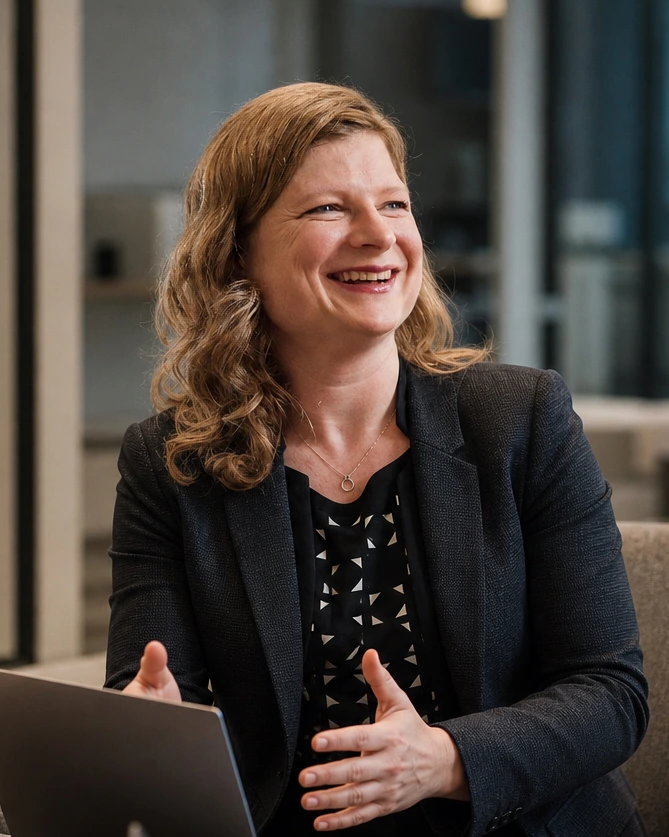
Jana Sedivy is VP Customer Experience and Product at InkBridge Networks, the company that builds and maintains FreeRADIUS - the open-source authentication software that handles the majority of global network authentication. Her career spans solid state laser research at the National Research Council of Canada and computer science research at Xerox PARC, where she contributed to 39 patents. As a customer research consultant, she advised organizations like Apple, Siemens, Adobe, and the Canadian Center for Cyber Security.
This year, Jana received a WBA Contributors Award for her work on Passpoint and OpenRoaming - an initiative designed to improve both the security and availability of Wi-Fi connectivity globally. You can find Jana on LinkedIn.
The security work that no one sees
Q: When someone asks what you do, how do you answer?
I usually say I work in network security, which prompts a follow-up, and then I explain that I work for a company that builds and maintains authentication software.
Authentication is the process that verifies who you are when you connect to a network - and FreeRADIUS, the product at the heart of what InkBridge does, handles the authentication for a significant portion of all internet traffic globally. More than half, maybe as much as two-thirds. We don’t have a precise way to measure that, but it’s a very large share.
Every time someone connects to a corporate network, a university Wi-Fi, or an ISP’s service, there is likely a moment where their credentials are verified by software our company maintains. We keep the right people in and the wrong people out. When organisations are moving to zero-trust security frameworks (increasingly the standard approach), authentication is what makes that possible. So while we sit in the networking space as much as cybersecurity, security is absolutely central to what we do.
Q: You’ve described what you work on as “invisible technology.” What do you mean by that?
I think of it in terms of dark matter.
In astrophysics, dark matter is something we can’t directly observe, but we know it exists because it’s what holds the universe together.
Invisible infrastructure is like that. Think about airports: the air traffic control system, the CAD software used to design the building, the booking systems that passengers never interact with directly. None of it is visible to the ordinary person passing through. All of it is essential.
Authentication is one of those invisible pieces. Without it, the internet doesn’t function as a safe, reliable system. It just falls apart. I find it rewarding to work on something that most people will never think about but that I know is fundamental to how our networked world operates. There’s a particular satisfaction to that kind of work.
Is cybersecurity a good career?
Q: Your background is in physics and computer science. How did someone with 39 patents end up as VP of Customer Experience?
The short version is: I followed what interested me.
I started at the National Research Council of Canada in the materials lab, working on quantum well silicon lasers, which are the lasers used in the optical systems that carry internet traffic. Even further down the stack than what we do now. I was working towards becoming a research scientist.
Then I became interested in how people interact with complex technology - what’s now called UX - and I moved in that direction. I spent years at places like Adobe and PARC working on product and experience design, trying to make technically complicated things usable for actual humans. Most of my patents come from that period.
What I’ve found at InkBridge is that those things aren’t as separate as they might seem. Building good products means understanding both what the technology can do and what the people using it actually need.
My role is to make sure we build what our clients need, and that working with us is as good as the product itself.
Q: Is cybersecurity a good career in 2026?
I think network security and cybersecurity is a good bet. The more interconnected we become through networks, the more important security becomes - and that trajectory is accelerating.
If you’re asking whether AI changes that calculus, my answer is that AI is not going to make the problems of cybersecurity disappear. If anything, it makes them more acute.
AI gives security professionals better tools; you can detect threats faster, put in better protections, be more productive. But the people on the other side have exactly the same tools. So what AI does is raise the stakes and increase the pace, not reduce the demand for skilled people.
For someone who is technically minded and willing to keep learning, this field offers real longevity. The threats don’t stop evolving, which means the work doesn’t stop being interesting.
Q: What are the security problems that concern you most right now?
A few things stay with me.
Quantum computing worries me in the longer term. People have started talking about “Q-day” - the point at which a sufficiently capable quantum computer can break current encryption standards. When I was an undergraduate physics student, quantum computers were a theoretical idea. They’re not any more, and the implications for anything that relies on current cryptography are significant.
More immediately, I’m concerned about the concentration of personal data in the hands of a small number of very large technology companies. Most people handed over that data when those companies seemed broadly benign. The relationship is turning out to be more complicated than that. The use of surveillance data for law enforcement purposes is one example of how this plays out in ways that weren’t part of the original bargain.
And the proliferation of connected devices - smart speakers, cars with built-in intelligence, devices embedded in our environments with or without our awareness - creates an enormous and growing attack surface. Most of those devices are insecure by default. The privacy and security implications are serious and not well understood by the people buying them.
Worth subscribing to.
Worth reading.
Our weekly newsletter covers network authentication tips, how-tos, security vulnerabilities, free resources, standards updates, and industry news. (All stuff you should stay up to date on!)
What it’s like as a woman in cybersecurity
Q: Early in your career, what were the signals you received about being a woman in science?
There was one moment that stayed with me longer than it should have.
Early in my career, I came across published guidance - formally published, the kind of thing you’d find in a professional library - on what it meant to be a successful woman in science.
It laid out, with complete sincerity, the different types of women in the field. Two of the types were failures in various ways. The third - the successful one - was a woman who had mastered a very precise balance: collegial enough to be accepted, distinctive enough to be noticed, but always calibrated around what made her male colleagues comfortable. The actual scientific work barely featured as a criterion.
It took me longer than I like to admit to recognise that framing for what it was. In hindsight it was useful information, in a backhanded way: it made clear that the expectations placed on women and the actual work of being a scientist were two entirely separate projects. You could spend your energy managing the first, or focus it on the second.
Q: ISC2’s 2025 Cybersecurity Workforce Study finds that around three-quarters of women currently working in the field describe it as a welcoming career path. Does that match your experience?
It does, and I want to be positive about this because I think that’s what’s useful.
Cybersecurity and network security is a field I recommend. InkBridge specifically is a place where what you know and what you contribute is what matters.
At the same time, I’d be doing a disservice to women considering this career if I pretended the broader landscape has fully caught up. Earlier in my career, going to technical conferences involved managing a kind of attention that had nothing to do with my credentials or my work. This was just a background condition. You learned to deal with it - certain positioning in social situations, a slightly higher level of situational awareness than your male colleagues were maintaining. I don’t encounter that in the same way any more. Whether that’s because the environment has improved, or because I’m a different person now - older, more senior, projecting differently - I honestly can’t say.
What I can say is that when I look around at technical conferences today, I still see very few women in the technical sessions. The composition hasn’t changed as much as I’d like. But it hasn’t stopped me doing the work. And I don’t think it should stop anyone.
What I’d say to a woman thinking about this field is: go for it, especially if you’re technically minded. The skills this field rewards - precision, systems thinking, the ability to understand complex interdependencies - are not gendered skills.
And the work matters. Authentication, security infrastructure, the systems that keep networks reliable and safe: these affect everyone who uses the internet, which is to say everyone. That’s not a bad thing to spend your career building.
Next steps
If this has you curious about a career in network security, we encourage you to connect with Jana on LinkedIn for a conversation; she's always happy to hear from people considering the field. And if you're exploring opportunities, see what's open at InkBridge Networks.
Related Articles
From nuclear physics to open-source monetization
A nuclear physicist's "hobby project" now authenticates half the internet and generates millions in revenue. Here's how he monetized what everyone said was impossible.
Client Case Study: Network authentication at scale
65% fewer authentication failures. 40% drop in support tickets. How InkBridge Networks is helping educational institutions by transforming their eduroam experience with protocol-level fixes.