When a vendor’s home government can cut off your software, the traditional safe choice stops being safe.
Jana Sedivy, VP Customer Experience & Product, InkBridge Networks
Vendor dependency risk used to be a line item in a procurement review.
On October 31, 2025, the International Criminal Court (ICC) made it a headline when it confirmed it was replacing Microsoft Office with openDesk, an open-source suite developed by Germany’s state-owned Centre for Digital Sovereignty (ZenDiS).
The court’s IT manager, Osvaldo Zavala Giler, told Handelsblatt that the ICC needed to reduce its dependencies and build technological autonomy, even if that proved expensive, inefficient, and inconvenient in the short term.
Vendor dependency risk is the exposure an organisation takes on when a critical system relies on a single supplier, so that whatever happens to the supplier happens to you as well.
For most of my career, that exposure was discussed in terms of outages, acquisitions, and vendors going bust. The ICC’s decision reflects a newer question that a lot of organisations in Europe and Canada are now asking: what happens if your vendor is healthy, online, and simply told to stop serving you?
What happened at the ICC
In February 2025, the US government placed sanctions on Karim Khan, the court’s chief prosecutor, over the ICC’s investigations involving the United States and Israel. In May 2025, the Associated Press reported, citing ICC staff, that Microsoft had cancelled Khan’s email address and that he had moved to Proton Mail, a Swiss provider.
(Microsoft disputes that framing. Its president, Brad Smith, has said the company never ceased or suspended its services to the ICC as an organisation, though he declined to explain how Khan lost access.)
The details of that one account are less important than what the episode revealed. A US company, bound by US sanctions law, sat between an international court in The Hague and its staff’s email. Whether or not anyone flipped a switch, the court realised that a foreign government had its hand near one. Five months later, it announced the move to openDesk.
Vendor dependency risk used to mean that a supplier might fail. Now it also means that a supplier might be ordered to stop serving you, by a government you did not elect and cannot lobby.
The safe choice has become the risky one
For decades, buying from Microsoft was the default. They lead their markets, they sell complete solutions, and “nobody ever got fired” for choosing them, so the saying goes.
What has changed over the last 18 months or so is that the unpredictability of US policy now attaches to the companies headquartered there, and buyers outside the US are pricing that in.
That is what people mean by digital sovereignty: an organisation’s or a country’s ability to control its own data, software, and infrastructure, including deciding whose laws apply to them.
Europe is moving fastest. The German state of Schleswig-Holstein has moved about 80% of its administration workplaces outside the tax office to LibreOffice, citing vendor lock-in and sovereignty.
France is rolling out Visio, a government-built open-source video platform, to roughly 200,000 civil servants by 2027 to replace Teams and Zoom. Each time, the same trade is being made: fewer features in exchange for control.
Europe’s caution extends beyond American vendors. In January 2026, the European Commission proposed a revised Cybersecurity Act that would let the EU designate “high-risk suppliers” from countries posing structural risks to ICT supply chains, and could require telecom operators and other critical-sector organisations to phase out their equipment.
The proposal is still under negotiation, and several member states have questioned whether the EU has the authority to impose it. The direction of travel is clear all the same. European regulators now treat a supplier’s home country as a security question.
As a Canadian, I find our position particularly uncomfortable. Research published in Policy Options in April 2026 found that about two-thirds of more than 750 software platforms used by Canadian organisations are run by companies subject to the US CLOUD Act, and only 17% are Canadian-owned. Ottawa announced plans for a sovereign Canadian cloud in September 2025, which is a start. Most organisations will have to manage their own exposure long before national infrastructure arrives.
Vendor lock-in turns dependency into a trap
Dependency is manageable if you can leave. Every vendor risk guide recommends diversification and an exit plan.
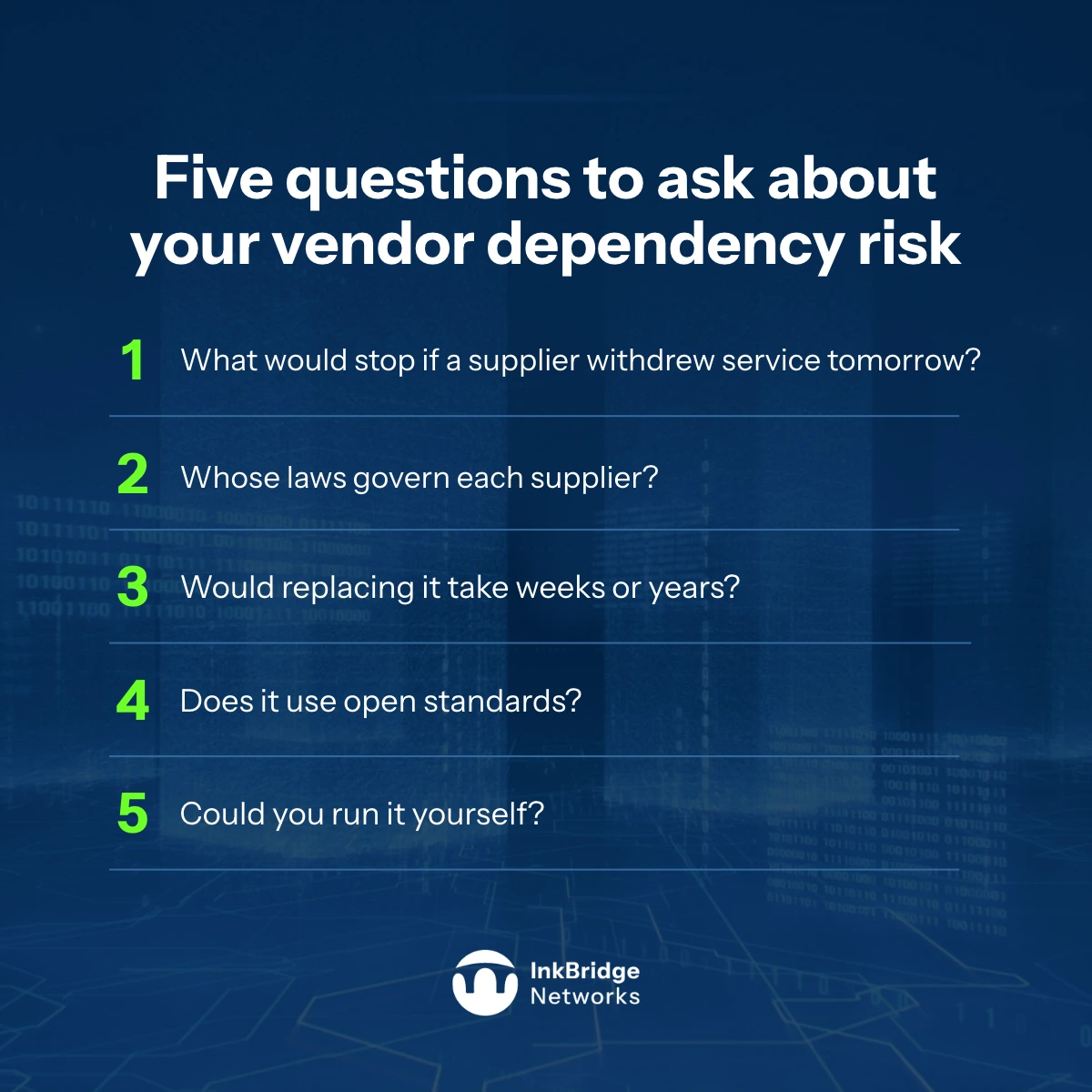
Five questions to ask about your own vendor dependency risk
The difficulty is that the biggest vendors are very good at making exit impractical: “Buy the whole suite and we will take care of everything: email, file storage, calendar, internal wiki, a website builder, one contract, and one point of contact.”
In networking, the equivalent is an access control platform that works best when everything around it comes from the same manufacturer. Our Cisco ISE alternatives guide covers how that ecosystem pull plays out in network access control.
Once your environment is coupled to one vendor, replacing a single component means replacing everything it touches.
Most of us know this from our phones. Once your apps, purchases, and photos live inside one company’s ecosystem, switching means rebuilding a big piece of your digital life, so most people never do.
Corporate infrastructure works the same way, with much larger numbers attached.
Cory Doctorow describes what comes next in his 2025 book Enshittification. Platforms start by serving their users well, then shift value toward their business customers, then claw it back for themselves once everyone is too invested to leave.
In enterprise software, it shows up as a licence change that moves the feature you rely on into a pricier tier, new terms of service you have no real choice about, or a product you depend on reaching end of life with a migration path that leads straight back to the same vendor.
Alan has written about how to avoid vendor lock-in when the licensing server itself becomes the point of failure.
Lock-in is what turns ordinary vendor dependency risk into a geopolitical one. If you can switch suppliers in a quarter, a sanctions dispute is an inconvenience. If switching takes three years and a budget you do not have, it is a crisis in the making.
Authentication is the layer you can least afford to lose
Network authentication rarely comes up in sovereignty debates, which is odd, because it is where vendor dependency risk can do the most damage. Authentication is the gate everything else passes through. If your RADIUS server stops answering, nobody gets onto the network to reach the email, the files, or the cloud services everyone is arguing about.
Worth subscribing to.
Worth reading.
Our weekly newsletter covers network authentication tips, how-tos, security vulnerabilities, free resources, standards updates, and industry news. (All stuff you should stay up to date on!)
This is where open standards and open source earn their keep. RADIUS is an IETF standard, so a standards-based server works with network equipment from any manufacturer.
FreeRADIUS, which InkBridge maintains, is open source. You have the code, you can run it on your own hardware in your own jurisdiction, and it stays yours to run for as long as you need it.
Open source does not eliminate dependency. You still rely on people who understand the software, which is why commercial support exists. The difference is that you choose who that is, and you can change your mind.
Questions to ask about your vendor dependency risk
Many organisations only examine their vendor dependency risk after something goes wrong. These questions are a way to do it beforehand.
Which systems would stop your organisation from operating if their supplier withdrew service tomorrow?
Which country’s laws govern each of those suppliers, and could a sanctions or export decision reach you through them?
How long would it take to replace each one, and is that measured in weeks or in years?
Does each system use open standards, so a replacement could slot in without rebuilding everything around it?
Could you run, patch, and configure it yourself if the vendor became unavailable?
The answers will not all be comfortable. They are much more useful before a crisis than during one.
Need more help?
If your team is wrestling with network configuration, a troubleshooting problem you cannot resolve, or a system that needs to be more resilient, we can help. InkBridge Networks has 25 years of expertise - we wrote the standards, maintain FreeRADIUS, and have seen every failure mode there is. Reach out to request a quote.
Related Articles

The real cost of free: What are the risks of open-source software?
Open-source software is free to download - but that’s where the economics get interesting. The internet runs on open source. Google is built on it. Microsoft Azure is built on it. The entire authentication infrastructure of the modern web depends on it.

Stop looking for FreeRADIUS alternatives
Afraid of FreeRADIUS? If worries about support, scalability, and security have you looking for alternatives, FreeRADIUS creator Alan DeKok explains why those fears are unfounded.